From Dry Points to Digital Objects
Thinking about Digital Objects and manuscripts.
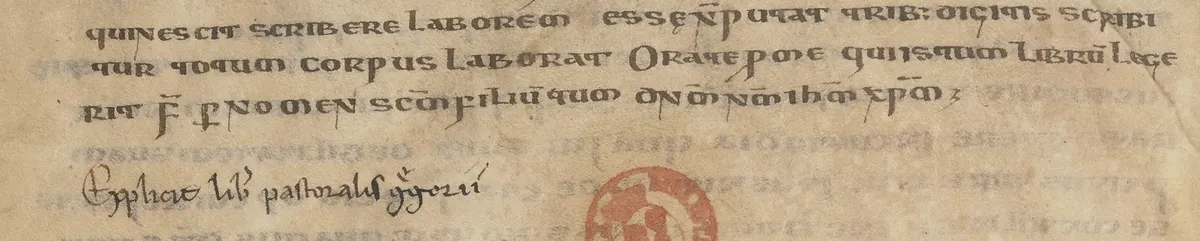 © Paris, Bibliothèque nationale de France, lat. 9561, fol. 81v.
Qui nescit scribere laborem esse non putat. Tribus digitis scribitur totum corpus laborat. Orate pro me qui istum librum legerit.
i am naïve with latin and manuscripts often appear to me as environments. ask me later about Kathryn Rudy's Touching Parchment and the Marshall McLuhan's Talk He Never Gave “Discarnate Man and the Incarnate Church".
NOTES
re: medieval digital objects
a manuscript is a set of pixels and a metadata scheme.
- what relations make up a digital manuscript?
the gloss is annotation, but it is also a medium — a later hand writing into an earlier surface.
- if a scratched gloss is a message, what is its channel, and who was meant to receive it?
- does treating the page as a medium change what counts as its content?
- when a scribe writes between the lines, are they reading or transmitting?
touchsense
the last register, and the one i keep circling. reading with the hands. the sense that touch is itself a way of reading a page — not a supplement to sight but its own channel.
- can touchsense be materialized, or does it escape every capture by definition?
- you can't capture feel. the open question is whether a neural network can even see that it has failed to.
- when a reading requires the hand — the offset impression, the trace you only catch by handling — what is it that the eye and the scan both miss?